In Support of Women Teachers and Leaders [1]
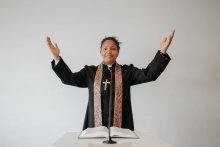
I have come to the conviction that women ought not to be universally prohibited from teaching and leading churches.
The journey of how my mind was changed on this matter includes a number of personal anecdotes. While I would love to share this story in full, I am going to restrain myself, lest these anecdotes be turned into targets for straw man attacks; whether my position is legitimate should be contested on the grounds of Scripture, not the journey that the Lord has led me on.
I anticipate two kinds of objections to this position. The first is the uncharitable claim that I “do not believe in the Bible”, or do not hold it with proper authority or reference. The argument is that the Bible is clear and unambiguous on the matter: 1 Timothy 2:11–14 states the prohibition that women may not be teachers or leaders within the church. I vehemently reject the accusations that I am ignorant of Scripture, that I do not hold it in sufficient high regard, or that I am pandering to liberal notions. I shall devote my next article to this passage and demonstrate that for anyone who holds Scripture and biblical theology in high regard, the plain reading is problematic.
The second objection will, perhaps, be a more tempered one, owing to it being a more complicated and elaborate systematic theology of complementarianism1. Men and women, the argument goes, have different, but complementary roles within the family, and within ministry. Adhering to these roles honours God and His created order. I’ll spend a portion of this article addressing parts of this argument, but don’t intend to do so exhaustively or comprehensively. I find this argument to be a non sequitur to the topic of women as teachers and leaders within the church. I am happy to accept that men and women could well have different God-ordained roles within family, and perhaps even society. However, these allocated roles are general, not absolute and universal. Also, it is a leap to generalise what the Bible says specifically about family life to all male and female interactions, and the organisation of church. 1 Timothy 2:11–14 is the only passage in the Bible which restricts women’s ministry. If it was absent from the Bible, it is hard to see how a complementarian case could be made to exclude women from ministry. Complementarians point to the reference to the created order in the passage to justify that women have complementarian, not equal, roles in ministry. Again, I shall address this passage in my next article. For now, it suffices to say that I believe that the complementarian “systematic theology” really hinges on this one passage.
In both complementarian and egaletarian theology1, the issues of woman teachers, leaders, and household headship are taken together. This article only focusses on the issue of woman teachers and leadership within the church. I do not see these issues as intrinsically linked to the issue of household headship, as I’ll explain below.
Compatibility with Complementarianism
Let us take, for example, Ephesians 5:22: “Wives, be subject to your own husbands, as to the Lord.” The argument goes that, if a wife is to submit to her husband, how can she have authority over her husband if she is the leader of a church? This line of reasoning seems obtuse to me: the context is clearly the organisation of the family, not ministry or church polity. It is also a general guideline, not a universal and absolute rule: wives ought not to obey their husbands if their husbands do to them—or command them to do—what is contrary to God’s Law. This is exactly how any faithful teacher teaches Romans 13:1: be subject, as long as it does not violate God’s Law. Also, Ephesians 5:22 specifically addressed wives, not women in general, so it is poor candidate to substantiate a general and universal prohibition on women teaching.
In my own family, we consider ourselves to be a team. As with many sports, each team member has a distinct role within the team to achieve an end goal. The team functions best if each member functions within their specific role. However, if one member is caught offside, incapacitated, or invalided out, it may be necessary for one of the other team members to (temporarily, but a permanent change could also be required) step into that role. Doing this will put strain on the team, because it is not how the team is intended to function. The purpose should not be to be absolutist about specific roles, but rather to achieve the end goal. We see this in Ephesians 5. I believe it is true that “Wives, be subject to your own husbands, as to the Lord” (v. 22), as well as “Husbands, love your wives, even as Christ also loved the assembly and gave Himself up for her” (v. 25), not because those are purposes in and of themselves, but because it achieves a wider goal: to be “wise” (v. 15), “redeeming the time” (v. 16), and “subjecting yourselves to one another in the fear of Christ” (v. 21).
Cultural Factors
In 1891, Rev. B. T. Roberts published his book Ordaining Women [2], in which he laid out his arguments for why women should be allowed to be ordained. Among other arguments, he draws a parallel between the movement to abolish slavery [3]. Slavery, similarly, had been defended as being “biblical”. However, as G. K. Chesterton put it, slavery wasn’t a biblical ideal, but a cultural norm:
[I]t is extraordinary how very little there is in the recorded words of Christ that ties him at all to his own time. I do not mean the details of a period, which even a man of the period knows to be passing. I mean the fundamentals which even the wisest man often vaguely assumes to be eternal. For instance, Aristotle was perhaps the wisest and most wide-minded man who ever lived. He founded himself entirely upon fundamentals, which have been generally found to remain rational and solid through all social and historical changes. Still, he lived in a world in which it was thought as natural to have slaves as to have children. And therefore he did permit himself a serious recognition of a difference between slaves and free men. Christ as much as Aristotle lived in a world that took slavery for granted. He did not particularly denounce slavery. He started a movement that could exist in a world with slavery. But he started a movement that could exist in a world without slavery. He never used a phrase that made his philosophy depend even upon the very existence of the social order in which he lived. He spoke as one conscious that everything was ephemeral, including the things that Aristotle thought eternal.
G. K. Chesterton, The Everlasting Man
This excerpt can be summarised as that the gospel is true whether a culture practised slavery or not2. The great Aristotle was incapable of conceiving a society without slavery. Today, we are abhorred by the idea of slavery. But Jesus “started a movement that could exist in a world with slavery, but He started a movement that could exist in a world without slavery.” Irrespective of whether slavery is morally reprehensible to a culture or not, the gospel can function within such a society.
The church bore with slavery for too long3, but eventually came to realise that the gospel of people created in the image of God is not compatible with slavery, and then worked to abolish it. But, before then, slavery was such an ingrained institution in the culture, that—like Aristotle—it was almost impossible to image a world without it. We can say that it was a cultural blind spot. Slavery was defended through a biblical lens for centuries. The Bible was used to justify—not by some fringe villains of history, but by sincere and learned theologians—slavery, the inequality of races, and Apartheid. Here, the Bible wasn’t used to speak for itself (i.e. the doctrine of the image of God), but was used to reinforce an existing worldview and cultural norms. Similarly, we may not know or realise how our culture, and the way we have been raised, may cause in us blind spots about the roles of women. We may be so deeply entrenched in it, that we cannot differentiate faithful Bible teaching from using the Bible to justify what we already believe because of culture. As an example: when Mary Wollstonecraft wrote A Vindication of the Rights of Woman, 1 Timothy 2:11–12 and 1 Corinthians 14:34–35 were used to justify denying women formal, basic education. She wrote in England in the 18th century; today, such severe restrictions are found (as a matter of law), only in Afghanistan [4]. The rest of the world has dropped the view that women ought not to be educated, and have certainly abandoned using the Bible to justify such a view.
Let us take yet another example, given in 1 Timothy 3, where the requirements for an overseer is given as “the husband of one wife”, and the head of a household. The question is, is Paul hinting at absolute gender roles within the church structure, or is he engaging with culture? The plain fact is that the Greco-Roman culture of the first century was highly paternalistic. It also accepted slavery. And so, when Paul wrote to Philemon, he did not explicitly condemn slavery or Philemon as a slave-owner, but sought to promote the Kingdom of God within the established culture of the day (Jesus “started a movement that could exist in a world with slavery”). There were several reasons why the gospel would have been considered “shameful” (Romans 1:16), and its high regard of women was one of them4. Sometimes it was necessary to push back against cultural critiques of the gospel story, and sometimes Paul manoeuvred within the cultural expectations of the day. That is what he did when writing to Philemon. And that is, arguably, what he did when he wrote to the church in Corinth that Christ “appeared to Cephas, then to the twelve” (1 Corinthians 15:5), making no mention of the very first people to whom Christ had appeared: the women who went to the tomb. Similarly, Paul might have had a reasonable expectation that, for socio-political reasons, the church in Ephesus would have male overseers during Timothy’s tenure there, without creating an absolute command that an overseer can never be a woman (whether married or not).
Another difficulty (for some theologically conservative churches) with this argument, comes from verses 8–13, where the qualifications of a deacon5 are given. Verse 12 says that “a deacon must be faithful to his wife and must manage his children and his household well” (NIV). But there are theologically conservative churches which allow for women to be made deacons. Therefore, they cannot use this line of argument to prohibit women from being elders using the very same argument which would disqualify them from being deacons. Paul himself wrote of the deaconess Phoebe in Romans 16:1. We even have a witness from the early second century speaking of deaconesses [5], demonstrating that the very early church did not think that the position was exclusively for men, despite what Paul wrote in 1 Timothy 3:8–13.
Regarding the absolute view of gender roles within the church, I am going to quote at length from Misreading Scripture with Western Eyes:
While I (Randy) was living in Indonesia, I was invited to speak at a “pastors only” meeting. In the audience of over one hundred pastors, I noticed a half-dozen women. The bylaws of the Convention of Indonesian Baptist Churches clearly state: “Pastors must be male.” I should have left it alone.
“I thought this meeting was for pastors only,” I remarked to the conference organizer.
“It is,” he replied.
“But there were women in the audience,” I pointed out.
“Yes.”
Now I was confused. “But your laws say pastors must be male!” I exclaimed.
The convention president calmly replied, “Yes, and most of them are.”
Goodness. His answer represents a fundamentally different view of law. To the non-Western mind, it seems, a law is more a guideline. Americans would likely want to change the Indonesian law to read, “Most pastors must be male,” and then we would argue over the percentage. The Indonesian—and arguably the biblical—view of law always left room for exceptions.
Paul states, “I do not permit a woman to teach or to assume authority over a man; she must be quiet” (1 Tim 2:12). “But what about Priscilla and Junia?” we might ask Paul. “They taught in church. You said women must keep silent.”
Perhaps Paul would answer, “Yes. And most of them do.”
E. Randolph Richards and Brandon J. O'Brien, Misreading Scripture with Western Eyes
The moral of the anecdote shared by Randy above, is that we may be so fixated on absolute rules in trying to please God and avoid sin, that we can easily slip into blind Pharisaicalism.
It is necessary to acknowledge that our cultural conception of gender roles may be so ingrained in us, that we cannot conceive “our” (as historically faithful Christians) view of gender roles as culturally contingent rather than divinely ordained. It could well be that the Bible has been used to justify the culture, rather than the culture shaped solely by being faithful to the Bible. This becomes apparent when brushing up against different cultures, such as the native African cultures here in South Africa. It is our responsibility to seek after the heart of God, and to see where our culture could be in opposition to that.
Liberal Slippery Slope
I have recently twice encountered the claim that churches which allow women to be ordained necessarily slip into liberal theology. This claim seems to come from Wayne Grudem’s book Evangelical Feminism: A New Path to Liberalism? It is true that this happened for all the churches in the period surveyed in this book (1956–1976). However, this may have been cherry-picked, as this did not happen for all churches which began ordaining women earlier, such as Assemblies of God, and certain Pentecostal and charismatic churches. Additionally, many Anglican churches in the global south allow for women to be ordained (even as bishops), yet remain theologically conservative, as is evidenced by the recent GAFCON break from Canterbury, precisely over the issue of liberal theology6. Instead of well-meaning orthodox churches deciding to ordain women, and then becoming theologically liberal, many churches first commit to liberal theology, and then decide to ordain women. The causation does not necessarily flow one way. The existence of theologically conservative churches which ordain women (some which have already done so for a hundred years or more), proves that a liberal slippery slope is not inevitable.
Kingdom Reality
I remember sitting in an expository teaching session on 1 Timothy 2:11–15. Perhaps sensing a “feminist” sentiment of the mainly (Gen Z) student audience, the preacher was very clear and direct that “this is what the text says” (the face value teaching), and that it must be accepted, because of the inspiration and inerrancy of Scripture.
It seemed to me like he was deliberately restricting the teaching to that one passage, whereas, at the event in general, we were trying to teach the students to read the Bible in its various contexts and to develop biblical and systematic theologies. Why did the preacher not take us to read the parallel passages on creation, Fall, responsibility, and redemption? In my next article, these parallels will be examined.
As humans, we crave to have rules that are guarantees; even people who claim that they don’t like rules. We want it to be true that, if we work hard and save for retirement, it will go well with us. We want it to be that, if we recycle and take care of the environment, things will go well. We want it to be that, if we don’t steal and murder and defraud, that it will (karmically) go well with us. We want people who break the law by stealing and murdering and defrauding to suffer consequences under that law. This is what the book of Proverbs says. But the book of Ecclesiastes is a counterweight to Proverbs: sometimes we follow all the “rules”, and we don’t get the outcome we thought we would be entitled to. Sometimes people break all the “rules”, and still come out on top.
Christianity which bases itself on the Kingdom of God (which is what Jesus taught about the most) stands—like a defiant middle child—between the extremes of rabbinic Judaism and Sharia. That does not mean that people don’t try to make Christianity rule-based: “absolutely always do this, absolutely never do that…”
I have noticed that American evangelicals, in particular, are eager to mine the Bible for “do’s and don’ts”, rather than hold it all in tension with the Kingdom of God [6]. As a result, “women cannot teach and preach” becomes a universal prohibition7, and a rule which must be kept, rather than understand the nature of creation and sin [7], and how to navigate that with wisdom and to the building for the Kingdom of God.
As Tim Mackie put it [8]:
We want God to have given us an exhaustive map, and what He offers is a compass.
Tim Mackie
F. F. Bruce (as related by Scot McKnight in his book Blue Parakeet) once said,
I think Paul would roll over in his grave if he knew we were turning his letters into torah.
F. F. Bruce
Conclusion
There are many nuances to all these arguments that I cannot hope to touch on in a single article without expecting it to run to the length of a book. I have only given the broadest outlines. My main intention was to “come out”, so to speak, as someone who believes that women can, and should, teach Scripture, and be allowed to be ordained. I did not arrive at this position because of feminism, revisionism, liberalism, modernism, or any other -ism8. I read Scripture, which I hold in the highest regard as the Word of God, and of Jesus’s teachings on the Kingdom of God, and hold all that it says in tension, rather than latch on to a couple of proof texts. My conclusion is that women, who were created as helpers (i.e. fellow workers), not as inferiors or subordinates [9] (Genesis 2:18, 20), and who have been freed by the blood of Jesus on the cross, ought to resume their roles as helpers in the work of the Kingdom of God.
- 1. a. b. Complementarian theology refers to the view that men and women are equal, but have different (but complementary) roles in society, family, and church, as ordained by God. Egaletarian theology refers to the belief that roles in these spheres of life can be shared equally by men and women.
- 2. In the previous chapter, Chesterton wrote that, with the birth of Jesus (the incarnation of God), “after that moment there could be no slaves. There could be and were people bearing that legal title until the Church was strong enough to weed them out, but there could be no more of the pagan repose in the mere advantage to the state of keeping it a servile state. Individuals became important, in a sense in which no instruments can be important. A man could not be a means to an end, at any rate to any other man’s end.”
- 3. In the fourth century, Gregory of Nyssa started to argue, from the doctrine of the image of God, that slavery is not right, that one man should not be able to own another one, and that all men should be free. This was a radical teaching at the time, not only because slavery was a cultural norm, but because slavery was (both practically and metaphysically) necessary in the Greco-Roman world. Some church started living out this conviction, by raising money to buy slaves, and set them free. This was so successful that, unfortunately and unintentionally, by the time of Augustine, it increased the slave trade, as it drove up the demand for slaves. Still, the church sought to lawfully set as many people free from slavery as they could. After this, it still took more than a thousand years for slavery to effectively be banned on a wide scale, but the seeds for working towards the eradication of slavery were sown by these early church leaders.
- 4. The second century critic of Christianity, Celsus, mockingly wrote that the claims of Christianity could “are able to convince only the foolish, dishonourable and stupid, and only slaves, women and little children.”
- 5. Although the WEB uses the word “servant” in this passage instead of “deacon”, the Greek word in verse 12 is “diakonos”, and is overwhelmingly translated as “deacon” in the translations that I checked, including translations to different languages.
- 6. Some people have claimed that GAFCON broke away from Canterbury because a woman, Sarah Mullally, was elected as archbishop. This is demonstrably false: not only do some of the churches in GAFCON themselves have female bishops, but they stated that their break was because of her endorsement of liberal theology [10]. In their meeting in Abuja in 2026, they deliberately did not elect a different “first among equals” precisely to try and avoid the appearance of the issue being about Mullally being a woman [11].
- 7. Within both Roman Catholicism and Eastern Orthodoxy, women may teach and preach to men. They are not allowed to be ordained as priests and deliver homilies which are part of the liturgy, but outside of mass, they may preach informally, teach theology at seminaries, speak at conferences to a mixed audience, etc.
- 8. I actually (and respectfully) disagree with the NIV translation committee’s decision to change “brothers” to “brothers and sisters” in parts of the New Testament. It’s not that I think what is said in those places aren’t applicable to women as well, but readers ought to understand how language was used in the time that these texts were written. In my opinion, encouraging readers to understand the use of language and author intent is more valuable than being gender inclusive. I am also of the opinion that, if woman are allowed to be ordained, no quotas should be enforced. If there is only one female teacher for every thousand men, as long as they are all in Christ and sufficiently qualified, then that is good.
Categories:
- Theology [12]
