


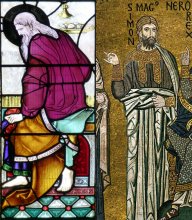
In this article I want to look at two men from the very beginning of the Christian story. Both are considered by orthodox Christians to be villains. I intend to argue that one of them was wrong in their understanding, and the other one was correct. Yet, even being correct, they still became a villain. And that is one of the most sobering thoughts imaginable for a Christian.
Judas
The character of Judas has perplexed Christians since Jesus’s betrayal. In him we find someone who was hand picked by Jesus Himself to be part of His inner circle, who witnessed Jesus’s miracles, heard His preaching, went out on mission for Jesus (Matthew 10), and even had his feet washed by Jesus Himself, yet still ended up betraying Him. While John 12:4–6 assures us that Judas was corrupt throughout his time of being Jesus’s disciple, he did know the message and the power of the gospel. He was so deeply involved in Jesus’s inner circle, that he has also been a puzzle for non-orthodox Christians, and even sceptics. In the gnostic Gospel of Judas, Judas is actually painted a hero, who was entrusted by Jesus with a secret mission, which he carried out faithfully, despite knowing that he would be vilified for it. In that retelling, Jesus’s betrayal wasn’t actually a betrayal, but an act of faithful service. As for sceptics, who believe that Jesus’s arrest, trial, and execution was a political matter, Judas is considered to be a scapegoat blamed by early Christians for Jesus’s arrest in order to spiritualise the crucifixion. How else, they argue, do you end up with a man who would betray his miracle-working and beloved (although controversial) rabbi of renown for the paltry sum of thirty pieces of silver?
Simon
Neither of our villains received substantial airtime in the New Testament. But for our other villain, in the early church, his infamy was legendary and much elaborated on.
In Acts 8:5–24, we meet a man named Simon, who, in English, has become known as Simon the Sorcerer. He was well known in Samaria for his sorcery, and “ma[de] himself out to be some great one”. Yet, when the gospel was preached in Samaria, and many people came to faith, Simon also expressed faith, and was baptised. He marvelled at the miracles which he saw Philip the Deacon do. Then came Peter and John to Samaria, and they prayed, and the Holy Spirit was poured out on people. This, more than the miracles which Simon had seen, impressed on him deeply; so deeply, that he offered Peter money to be given the ability to let the Holy Spirit come on people. Peter rebuked him for such a foolish offer. The last that we hear of Simon in the Bible is where he asks Peter to pray for him, so that what Peter had said about him may not come true.
While the name “Simon the Sorcerer” might sound quaint to some today1, his name in Latin, Simon Magus, has a more sinister ring to it. His story continues in the early church fathers. They tell of how he travelled to Rome and, along with a woman named Helen (who was claimed to be a reincarnation of Helen of Troy), set up a cult around themselves. He has been called “the father of gnosticism”, because his teaching syncretised Christian and neo-Platonic teachings, which were hallmarks of later gnosticism. While his own teaching has been referred to by scholars as “proto-gnosticism”, Menander, one of the gnostic teachers, apparently was part of Simon Magus’s cult. As such, in the eyes of the early church fathers, Simon Magus, as the progenitor of gnostic heresies, became a great villain, not unlike Judas.
I am not qualified to say whether these stories by the early church fathers are embellishments, or stories of different people which were blurred and merged over time. But through these stories, his legacy as a villain of Christian orthodoxy has been solidified.
Differences
Simon dabbled in sorcery. What precisely that means, and how people were impressed by and drawn to it, we don’t know. But he saw the miracles of the early Christians, and he was fascinated by them. He seemed to love the power: whatever it would be that would make him great and famous and important. Although he contained himself while he “followed” Philip around and observed his miracles, he could no longer do so when he witnessed the outpouring of the Holy Spirit. This power, the unleashing of God Almighty Himself, called out to his corrupt heart like a siren.
But for Judas, I want to argue, it was the opposite. He did witness miracles and Jesus’s unique and stirring teaching, but because he had deep insight into what Jesus taught about the coming of the Kingdom of God, he knew that the miracles were not an end in and of themselves. They were markers to an ultimate reality to which people were called. Unlike Simon Magus, Judas didn’t desire power and fame, but money.
People think that Judas was blinded by greed. But, perhaps, he saw all too clearly. Perhaps he saw Jesus’s vision of the Kingdom, and simply didn’t want part of it. Perhaps it seemed quaint, but not as exciting as, say, witnessing an apocalyptic and conquering warrior messiah who ushers in a period of material prosperity. Judas made a decision: whatever Jesus was selling, he wasn’t interested in buying. Those words seem bizarre to me as I write them, but the reality is that most of the world rejects Jesus’s vision and mission. Even if much of evangelism today is a message of “repent and go to heaven”, Jesus’s words about the Kingdom of Heaven are stark in the gospels, and either attract, or repel, many people. Judas knew that, beyond the miracles, lay the Kingdom of God, which was characterised by love, charity, self-sacrifice, obedience, and humility. Perhaps, after a time of consideration, he realised that that vision of reality didn’t appeal to him (Luke 22:3, John 13:27). He desired la dolce vita. And as he planned to extricate himself from the Jesus movement, he thought that he might as well get some money out of his privileged position.
Hell, and Those Who Reject the Kingdom
Pertinent to a discussion of these villains of Christianity, is their punishment: hell If rejection of Jesus is fundamentally a rejection of the Kingdom of God (and what that implies for how one desires to do for eternity), that raises and interesting perspective of hell. It aligns with C. S. Lewis' description in The Problem of Pain that “the doors of hell are locked on the inside” (author’s emphasis). Hell, therefore, is not vindictive punishment for people who refused to follow arbitrary rules concocted by God. It is the persistence of rejecting God’s vision of how creation should function. Hell is simply more appealing for some than heaven2. This is not necessarily masochistic irreverence, but realism. Remember that, in the parable of the Rich Man and Lazarus (Luke 16:19–31), the rich man never asked to be freed from his torment, even though he clearly thought that the chasm could be crossed. He wanted Lazarus to come to him, so surely it would have been possible for him to cross to Abraham. But hell is hell, not because it is a place where tortures are meted out on lawless and immoral people by demons, but because it is the absence of God.
The Kingdom Project
Many people are along for the ride (i.e. mingling in Christian circles and enjoying benefits from being there) without any intention of settling at the destination (i.e. Jesus’s teaching about the Kingdom of God), like Judas. Many people who think they are building for the Kingdom (or at least think they are effective at fooling other people and God) won’t make it to heaven (Matthew 7:21–23). Paul wrote that he had “the… desire to depart and be with Christ” (Philippians 1:23), but understood that the Kingdom project still required him to labour on earth. There are some of us who feel that, even if there was no promise of eternity and resurrection, it is still good and right and proper to build for God’s Kingdom. It’s not about being in it for the personal reward, but for the project, which is bigger than any one of us. It is about not living a selfish existence, but living out our purpose as selfless beings.
Conclusion
We all have an inclination (or a firm belief) of what ultimate reality should be. The same is true for a vision of the world after we die, and what our experience (if any) will be. It can be grating to come up against the possibility that we are wrong. I remain convinced that Jesus’s death and resurrection point us to an objective reality of the Kingdom of God coming in its fullness. If this is true, it will rub against what many people really want to be true. In a conscious afterlife, do we desire an eternity that is self-centred and about pleasures? Or do we desire to finally be whole again, and live and function as we were designed and made to be?
- 1. The historic figure lent his name to a whimsical computer adventure game.
- 2. Some people openly say “I’m looking forward to going to hell, because all my friends will be there”.
- . Photo credit: GadgetSteve.





Latest comments